Showing posts with label Maundy Thursday. Show all posts

Thursday, April 18, 2019

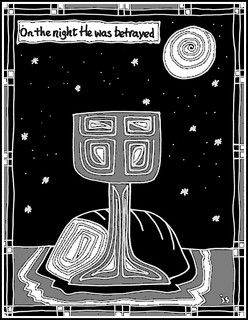
Maundy Thursday Poem - Remembrance


Remembrance

The night in which He was betrayed,
Jesus took unleavened bread,
And blessed the loaf before His friends,
To show a love that never ends.

“This is My Body,” Jesus said,
And handed out some bits of bread
“Broken for you,” He simply taught them,
“So all your sins can be forgotten.”

After supper, He took a cup,
And pouring wine, He filled it up.
“This is My blood, shed for Your sin,
To cancel death and let love win.”

They did not know all that He said,
Would be forever shared and read,
Through all the world, His love displayed,
This night, in which He was betrayed.

© John Stuart 2019


Thursday, April 13, 2017

Maundy Thursday Message - The Art of Betrayal

Based on Matthew 26


The Conspiracy

            Some of the best Shakespearean plays involve a pattern of betrayal which usually brings tragedy to one of the characters on stage. Macbeth betrays naïve King Duncan by enticing him to lodge at his castle, where the sovereign is callously murdered. Hamlet’s father is killed by his ambitious brother, which causes the young Danish prince to focus solely on revenge at the cost of betraying his true love, Ophelia. Othello’s uncontrolled jealousy culminates in the murder of his innocent wife Desdemona due to the treacherous words from his associate Iago. And Julius Caesar, who would not beware the Ides of March, is assassinated by a handful of rival conspirators, led by his friend Brutus, whose name becomes synonymous forevermore with the violent word ‘brutal.’ 

            When we read the whole chapter of Matthew 26, it feels very much like a Shakespearean tragedy. The chief priests, envious of Christ’s popularity, conspire to kill Jesus but decide to put it off until after the immense crowds of Passover pilgrims have left Jerusalem. They don’t want to cause a riot by arresting Christ publicly because they fear a negative reaction from the people, as well as being charged by the Romans of causing a rebellion. They plot to eliminate Jesus, but their plans are frustrated by the fact that the timing is not convenient.

The Opportunity

            And then, in what appears to be an answer to their wicked prayers, an opportunity arises which they cannot turn down. One of Christ’s own followers, Judas Iscariot, approaches them with words which must have sounded like music to their ears: “What will you give me?” he asks, ‘if I deliver Jesus into your hands?”

            Judas, as one of the Chosen Twelve, has been with Jesus for almost three years. He’s an insider who knows every move that Jesus will make. He was supposed to be a devoted disciple, but something has turned him into a treacherous traitor. He is ready to place Jesus into the hands of his enemies, but he wants to ensure that it will be both sanctioned by the priests and personally profitable to him. Instead of being a godly servant, Judas becomes a greedy sinner; rather than faithfully be with Christ to the end, he decides that Christ’s end has to finally be. All Judas needs is an assurance that he will be amply rewarded for this wicked act of betrayal. The religious authorities are willing to give him what he wants in order to get what they desire most: the end of Christ’s life and ministry.


The Audacity

            Judas is fully committed to betraying Jesus. Even when Christ is eating with the twelve disciples in the upper room and tells them that one of their own is going to betray Him, Judas does not relent or repent. Even when Jesus expresses words of extreme caution against anyone who would deliver Him into His enemies’ hands, Judas has the audacity to look Christ in the eye and feign innocence by stating, “You don’t mean me, do You, Teacher?”

            It’s all a convincing act, worthy of a performance in a Shakespearean drama. Judas is attempting to deceive Christ, even though he knows within his own treacherous heart and mind, that Jesus is perfectly aware of what he is about to do. In the end, the only one that Judas deceives is his very own self. He betrays his own soul and callously embraces the damnation that he is about to bring upon himself. In thirty life-changing seconds, Jesus has given his unfaithful disciple the opportunity to confess, but Judas rejects this final offer of grace and commits himself to greed, in order to receive thirty pieces of silver.

The Treachery

            The final act of treachery takes place in a secluded garden under the cover of darkness. Jesus knows what is about to happen and is sweating blood, as He wrestles with God in prayer, seeking to find a last-minute reprieve from the ghastly fate that awaits Him. His three most trusted disciples, Peter, James, and John, are meant to be guarding Him, but they’ve all had too much to eat and drink, so they’re fast asleep when the armed and violent vigilante mob reaches Jesus.

            At the forefront of the rabble is Judas and, in one despicable act of cowardice and betrayal, he greets Christ with a polite, salutary kiss, using it as a pre-arranged poisonous signal to point out which of the Galileans is the leader of the group. And to make certain that the mob knows that this is Jesus, the traitor speaks aloud the words: “Greetings, Rabbi!” All of which, in this case, actually means, “Here He is – this is the rebel you came to capture!”

            Jesus, however, has the last word and what He says may surprise us. He could have defiantly shouted, “Do your worst, traitor!” or “God will punish you for this, betrayer!” or even, “You have just damned yourself for all of Eternity, my enemy!” Instead, even at the very end, Jesus responds to this audacious act of treachery with words that shows us and Judas how much He loves the sinner:
“Do what you came for – Friend.”


Thursday, March 24, 2016

Maundy Thursday devotion: A Deadly Peril

2 Corinthians 1:10 He has delivered us from such a deadly peril, and He will deliver us again. On Him we have set our hope that He will continue to deliver us.

            Maundy Thursday is one of the most solemn days on the Christian calendar. I get deeply immersed in the gravity of this day, as well as the painfulness of Good Friday. Both days weigh heavy upon my soul and a spiritual gloom almost overwhelms me. Christ’s betrayal emotionally distresses me; Christ’s crucifixion spiritually depresses me.

            I understand that Easter Sunday is just around the corner and that I will be cheerfully celebrating three days from now. However, today deeply affects my soul because I recognize myself in the villains of the story, and my despicable part in Christ’s downfall.

            I think most Christians understand these feelings. We serve Christ each day of the year in our congregations and communities. We share our faith by helping others in times of need and showing love in times of distress. We want other people to experience and embrace the joy of Jesus Christ, which we honestly believe will help them immensely in their daily lives.

And then we encounter Christ, betrayed and abandoned, arrested and beaten, humiliated and executed. The joy disappears and His love is diminished; inhumanity is unleashed and injustice is unfettered. Instead of the Lord of our lives, we read about the suffering servant; instead of the Holy Son of God majestically enthroned in Heaven, we see the horribly battered human being gruesomely pinned to a man-made Cross.

Jesus went through all of this for us, which is why Paul’s words have a poignancy and relevancy on this day: He has delivered us from such a deadly peril, and He will deliver us again. On Him we have set our hope that He will continue to deliver us.


Prayer:            Lord Jesus, forgive us. Amen.

Thursday, April 05, 2012

Maundy Thursday Homily devotion sermon: On This Night

On This Night

Mark 14:37-38            Then Jesus returned to his disciples and found them sleeping. "Simon," he said to Peter, "are you asleep? Could you not keep watch for one hour? Watch and pray so that you will not fall into temptation. The spirit is willing, but the body is weak."

When I was a lot younger and ministering in Scotland, I used to come in from a hard day’s work in the parish, sit down to my dinner, and watch the evening news. It became an important part of my life and every night, between 5 to 6pm, I was engrossed in local, national, and international reports. I spent the whole hour try to cram in as much news as I could because after 6pm, the phone would ring and I would either be going out to yet another church meeting or a parishioner’s home for an emergency call. That whole hour became my lifeline between the real world and church world.

Late at night, I would catch up with my favorite sitcoms, documentaries, or sci-fi shows. They usually lasted for an hour and helped me to unwind. I could release the tensions of the day by watching a show that I liked. It was not only entertainment, it was a very easy way to chill out and relax, or as they say today to chillax. Watching television for an hour without having to think, make decisions, or settle issues was a daily blessing.

These days, because I am much older, I’m not into the evening news. It’s more like the evening snooze that I enjoy. Most of the time when I get back home, I start watching an hour long program and then find myself waking up just as the credits are being screened at the end. Like most of my peers, I’m so tired at night that I cannot even watch TV for an hour. I used to laugh at my Dad when he was my age or Evelyn’s parents who did the same. I now understand their weariness and tiredness and the need to snooze and nap. The older you get, the sleepier you become. I guess it’s God’s way of slowing us down and getting ready for His peace.

When Jesus went to pray in the Garden of Gethsemane, He needed His disciples to watch over Him. He was vulnerable and scared, anxious and fearful. He knew what He had to do, but He didn’t want to go through it. When he says to Peter that “the spirit is willing, but the body is weak,” he wasn’t just chastising the disciples for falling asleep; he was also expressing what Christ himself had just experienced: His spirit was willing to accept what God required, but His body was frightened about what that would entail.

When I read about the disciples falling asleep, I easily recognize my own humanity. They’re tired, full of food and rich wine. The last thing that they want to do is stand guard. It’s a beautiful moonlit night and they’re outside in the fresh air watching the stars. All they want to do is nap and snooze, sleep and dream.

But there’s an even greater display of humanity going on in the Garden of Gethsemane. A young man, at the age of 33, is wrestling with God and fighting off the temptation to run. Like anyone of us, Jesus doesn’t want to die, and yet he also knows that without His death, no other human being will ever be given everlasting life. He wants to please His Father in heaven, but Jesus also pleads with Him for a different solution. He wants to do the right thing, but Christ also struggles with how that will be accomplished. His Spirit is very willing, but his body is very weak.

Tonight, on Maundy Thursday and this terrible night we call Tenebrae, a darkness enters into the world, our church, and our souls. For on this night, we remember that night when Jesus, the Light of the World, was betrayed by Judas, the servant of darkness. Christ represented the life and love of God, whereas Judas displayed the deceit and depravation of humanity. That night touches us because we know in our hearts of hearts that we betray Christ each and every day with our arrogance, our pride, our self-centered ways, and self-opinionated ideas.

Thank God that Jesus made the right decision! Praise the Lord that Christ took up that cup of bitterness, judgment, and wrath and swallowed it completely. It was meant for us; it was not meant for Him. We are sinful creatures, whereas He is the sinless Christ.
Our bigotry betrayed Him; His beauty blessed us.
Our conceit condemned Him; His crucifixion captured us.
Our fallen humanity leads to Hell; His faithful holiness leads us to Heaven.
Our sins slaughtered Him; His sacrifice saved us!

Centuries ago, the great revivalist Charles Wesley wrote these opening words for a hymn that is still sung in Britain during Holy week.


And can it be that I should gain
an interest in the Savior's blood?
Died he for me, who caused his pain
for me, who caused his bitter death?

Amazing love! How can it be
that thou, my Lord, should die for me? 
Amazing love! How can it be
that thou, my Lord, should die for me? 


On this night, Jesus decided, of His own free will, to die for us. Amen.

Reflective silence before the Communion.

Thursday, April 05, 2007

Maundy Thursday

On the night in which Jesus was betrayed, He took some bread and wine, saying, "This is My Body; this is My Blood. Take, eat, drink, and remember Me."


On The Night

Worship Bulletin cover for Maundy Thursday service

Thursday, March 29, 2007

Holy Spirit

Audio Version here

John 16:8 When he comes, he will convict the world of guilt in regard to sin and righteousness and judgment:

Some people think that the work of the Holy Spirit is just to infuse everyone with dynamic energy so that worship services, ministries and missions can be made more effective, positive and amazing. Far too often, we have this idea that the Holy Spirit is the fizz in our spiritual lives that makes us feel better as Christians. But from this passage today, Jesus reveals to us that the prime purposes of the Holy Spirit are to convict us of our sin and disbelief; to show us what righteousness is; and to judge the world for its failures to accept Christ.

If we think about it deeply, we begin to realize that this is what Easter expresses to us. On Maundy Thursday, the night in which Jesus was betrayed, we all feel guilty because we recognize that any one of us could have been Judas. We say that we love and worship Jesus, but how many times each day do we cast aside His counsel and throw away His words?

On Good Friday, we are shown what righteousness is when we see Christ crucified on the Cross. We see our Savior dying for the world and we realize that it’s only His goodness that prevents God from destroying the world again.

And then on Easter morning, we experience the almighty power of God and Christ’s authority over the world, flesh, and the devil. They tried to keep Christ dead forever, but His righteousness prevailed so that this world and its Satanic prince are judged for all of eternity.

And how do we know that these things are true? Through the work of the Holy Spirit, because He takes away the veil that covers our hearts and minds. He opens the doors of understanding; He brings us to that sacred moment of recognition, revelation, and realization because He confronts, convicts and afflicts us with these eternal truths.

Prayer: Holy Spirit, You are more than we can understand and wilder than anything we can control. You enter our hearts and minds, penetrating our thoughts and ideas. We are afraid of You because of the truths about ourselves that You reveal. Come into our lives and help us to accept Your holiness, knowing that it will challenge and change all of us. In Christ’s Sacred Name, we pray. Amen.